









Inositol is a sugar-like substance that occurs naturally in your body and is also found in food. Your kidneys produce about two grams of it per day from glucose. Inositol exists in nine different forms, of which myo-inositol is by far the most common. D-chiro-inositol (DCI) is the second known form, and the two are often combined in supplements in a fixed ratio.
On this page you will read about the different forms, what they are found in, what a 40:1 ratio means exactly, and what to look out for when choosing an inositol supplement.
Is inositol a vitamin?
No. Inositol used to be considered part of the vitamin B complex and was even called vitamin B8 at the time. This classification was abandoned when it became clear that the human body produces inositol itself. A vitamin is by definition a substance that your body cannot produce itself, so inositol does not fall into this category.
You will therefore come across terms such as pseudovitamin or vitamin-like substance. Formally, inositol is a polyol, a sugar alcohol, and it is a building block of your cell membranes.
What foods contain inositol?
Inositol is found in fruit, legumes, nuts and whole grains. Citrus fruits and melon contain relatively high amounts of free myo-inositol. In grains, nuts and legumes, inositol is largely bound as phytic acid (phytate), and your body absorbs this form less effectively because an enzymatic conversion is first required.
| Source | Form of inositol | Bioavailability |
|---|---|---|
| Citrus fruit (orange, grapefruit) | Free myo-inositol | Good |
| Melon (cantaloupe) | Free myo-inositol | Good |
| Whole grains | Mostly phytate | Limited |
| Nuts and seeds | Mostly phytate | Limited |
| Beans and legumes | Mostly phytate | Limited |
D-chiro-inositol occurs in much smaller amounts in food. The best-known sources are carob, buckwheat, chickpeas and pumpkin seeds. Carob is also the raw material from which DCI for supplements is extracted.
Food tables do not always distinguish between free inositol and phytate-bound inositol. As a result, figures for the inositol content of food vary widely and are difficult to compare.
What types of inositol are there?
There are nine stereoisomers of inositol: nine molecules with exactly the same chemical formula, but with the hydroxyl groups in a different spatial arrangement. Six of these occur in nature, while three are only produced in the laboratory.
| Form | Occurs in nature | Role |
|---|---|---|
| myo-inositol | Yes | By far the most common form, also in the human body |
| D-chiro-inositol | Yes | Formed in the body from myo-inositol |
| L-chiro-inositol | Yes | Rare |
| scyllo-inositol | Yes | Occurs in small amounts |
| muco-inositol | Yes | Occurs in small amounts |
| neo-inositol | Yes | Occurs in small amounts |
| allo-inositol | No | Synthetic only |
| epi-inositol | No | Synthetic only |
| cis-inositol | No | Synthetic only |
In practice, it is always about the first two. Because myo-inositol is so dominant, the term inositol is often used on labels and in articles when myo-inositol is intended. Pay attention to this when comparing products: "inositol 1000 mg" on a label says nothing about the ratio between myo and DCI.
What is myo-inositol?
Myo-inositol is the most common form of inositol in the human body. It is found in virtually all tissues and cells and is part of the cell membrane. It is the form you most often encounter in supplements, in powder and in capsules.
Myo-inositol is also the precursor of D-chiro-inositol: your body converts myo-inositol to DCI through an enzymatic process. How efficiently this conversion takes place varies from person to person and from tissue to tissue.
What is D-chiro-inositol (DCI)?
D-chiro-inositol is the second known form of inositol. The body produces DCI itself from myo-inositol. In food, DCI occurs only in very small amounts, much smaller than myo-inositol, so you hardly get any noteworthy amounts from your diet.
DCI for supplements is extracted from carob pods. The origin of that carob largely determines the purity of the final product.
What does the 40:1 ratio mean?
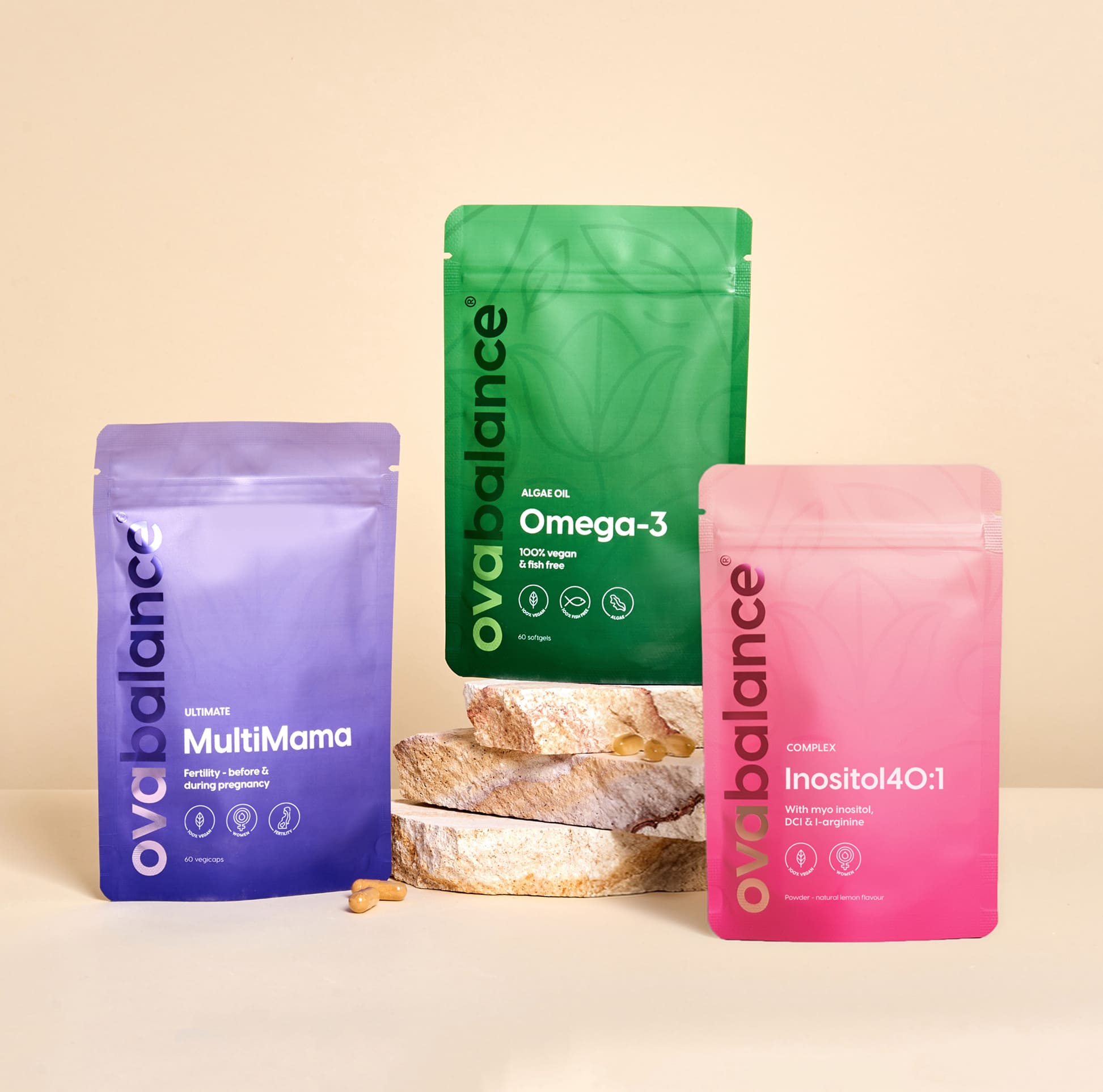
A 40:1 ratio means 40 parts myo-inositol to 1 part D-chiro-inositol. For the Ovabalance Inositol 40:1 Complex, this amounts to 3120 mg myo-inositol and 78 mg D-chiro-inositol per daily dose of one scoop (4.5 grams).
That 40:1 ratio was not chosen at random: it is the ratio in which myo-inositol and D-chiro-inositol are found in human plasma. Manufacturers use that as a starting point for the composition.
You will also come across other ratios, for example 5:1. These are based on the ratio as measured in other tissue. Therefore, always compare the absolute milligrams per daily dose, not just the ratio.
Myo-inositol or DCI: what is the difference in practice?
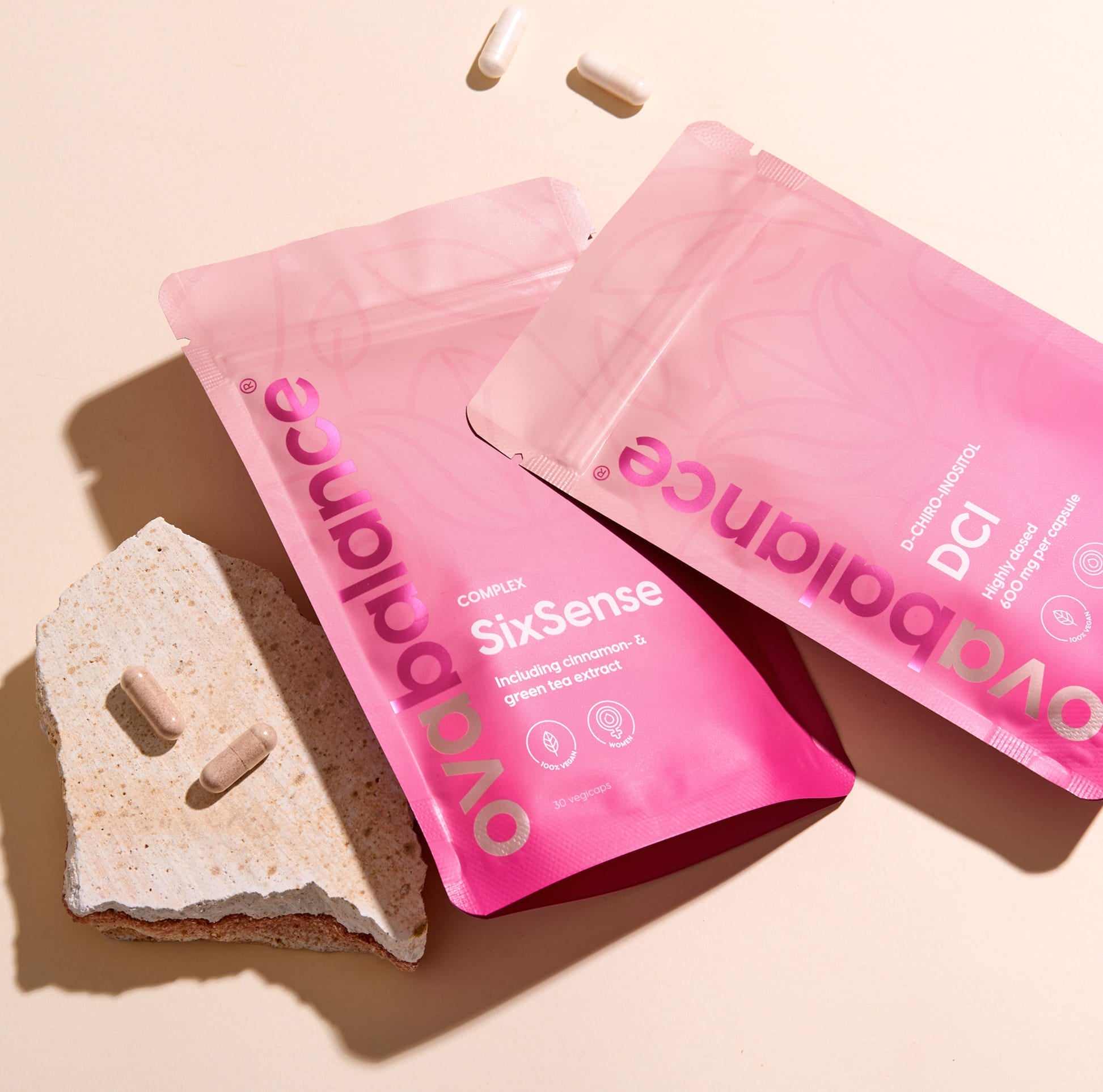
The practical difference lies in the dosage and the form. A 40:1 complex provides a lot of myo-inositol with a small amount of DCI. A pure DCI supplement provides the opposite: no myo-inositol, but a lot of DCI. The two Ovabalance products are shown side by side below.
| Inositol 40:1 Complex | D-Chiro-Inositol (DCI) | |
|---|---|---|
| Form | Powder, soluble | Capsules (plant-based, HPMC) |
| Myo-inositol per daily dose | 3120 mg | 0 mg |
| D-chiro-inositol per daily dose | 78 mg | 1200 mg |
| Ratio myo : DCI | 40 : 1 | No myo-inositol |
| Other active substances | 800 mg L-arginine | None |
| Daily dose | 1 scoop of 4.5 grams | 2 capsules of 600 mg |
| Package contents | 137 grams, approximately 30 doses | 60 capsules, 30 doses |
| Taste | Natural lemon flavor | Unflavored |
| Auxiliary and filler substances | None | None, only the capsule shell |

The DCI capsules therefore contain over fifteen times as much D-chiro-inositol per day as the 40:1 powder. Which of the two suits you depends on your personal situation. Due to European regulations on food supplements, we cannot give individual advice on this. Our product advisors can help you list the differences. In myo-inositol or DCI we set all the figures side by side in more detail.
Powder or capsules: which do you choose?
The difference is mainly practical. In powder form you take a high dose at once, something that is difficult with capsules: for 3120 mg myo-inositol you would have to swallow five or six capsules. For smaller amounts, such as pure DCI, a capsule is actually more convenient and easier to take with you.
| Powder | Capsules | |
|---|---|---|
| High dose at once | Yes | Only with multiple capsules |
| Easy to take on the go | Less convenient | Easy |
| Adjustable dosage | Yes, with the scoop | Per whole capsule |
| Noticeable taste | Yes | No |
| Auxiliary substances required | No | Capsule shell, sometimes filler |
The Ovabalance powder has a natural lemon flavor and dissolves in water, juice or a smoothie. There are deliberately no sugars or sweeteners to mask the taste. A more detailed comparison of all administration forms is in powder, capsule, softgel or tablet.
What to look out for when buying an inositol supplement?
Compare products on five points, and always use the daily dose as a unit, not the amount per capsule or per 100 grams. That is where most comparisons go wrong.
- Milligrams per daily dose. A label that states "600 mg per capsule" only says something when you know how many capsules the daily dose is.
- Exactly what form is in it. Inositol on a label is usually myo-inositol. If DCI is listed, look at how much.
- Purity and origin. For DCI, the origin of the carob is decisive. Ovabalance uses carob from Spain and works with a purity of at least 98 percent, with more than 140 quality controls per batch.
- Auxiliary and filler substances. Many products contain fillers, anti-caking agents or sweeteners. Look at the full list of ingredients, not just the nutritional table.
- Packaging. A doypack and a blister pack protect the product similarly. Blisters look more luxurious but produce more waste because the aluminum and the plastic are stuck together.
Why is there so little about the effects on this page?
Because European law does not allow it. Food and health claims for supplements are regulated in Regulation (EC) 1924/2006. Only claims that have been approved and included in the EU register may be used. For inositol and for L-arginine, no health claims are currently permitted.
That does not mean that there is no research on it. It means that we as a seller may not make statements about what the substance would do in the body, even if we refer to research. What we can and want to share is exactly what is in it, in what quantity, in what form and where it comes from. You will find that information above and on every product page.
If you want to know more about the scientific state of affairs, you can turn to independent sources such as PubMed, or your general practitioner, gynecologist or dietitian.
Frequently asked questions about inositol
Does inositol affect the working of the contraceptive pill?
No. However, the pill can mask certain signals from your cycle, making it harder to assess what a supplement does for you.
Can I use myo-inositol and DCI at the same time?
Yes. The 40:1 Complex already contains both forms. If you combine the powder with separate DCI capsules, then keep an eye on the total daily intake and consult your doctor if in doubt.
How long do I have to use it before I can assess anything?
For food supplements in general, a period of at least eight to twelve weeks of daily use applies before you can form an opinion.
Can I use inositol during pregnancy?
We advise against the use of the Inositol 40:1 Complex during pregnancy and breastfeeding. Our advice is to stop as soon as you have a positive pregnancy test. For that period, look at MultiMama Ultimate.
Important to know
Food supplements are no replacement for a varied diet or a healthy lifestyle. Do not exceed the recommended daily amount. Do you use medication, are you pregnant or breastfeeding, or do you have questions about supplement use? Then always consult a doctor or other expert.
Sources
- European Commission, EU register for food and health claims
- Regulation (EC) No 1924/2006 on food and health claims for foods
- Thomas MP, Mills SJ, Potter BVL, The Other Inositols and Their Phosphates: Synthesis, Biology and Medicine, Angewandte Chemie International Edition, 2016
- Voedingscentrum, about food supplements
Last substantively checked on September 1, 2026.
Read also: myo-inositol or DCI, powder or capsules and inositol, berberine and NAC compared.